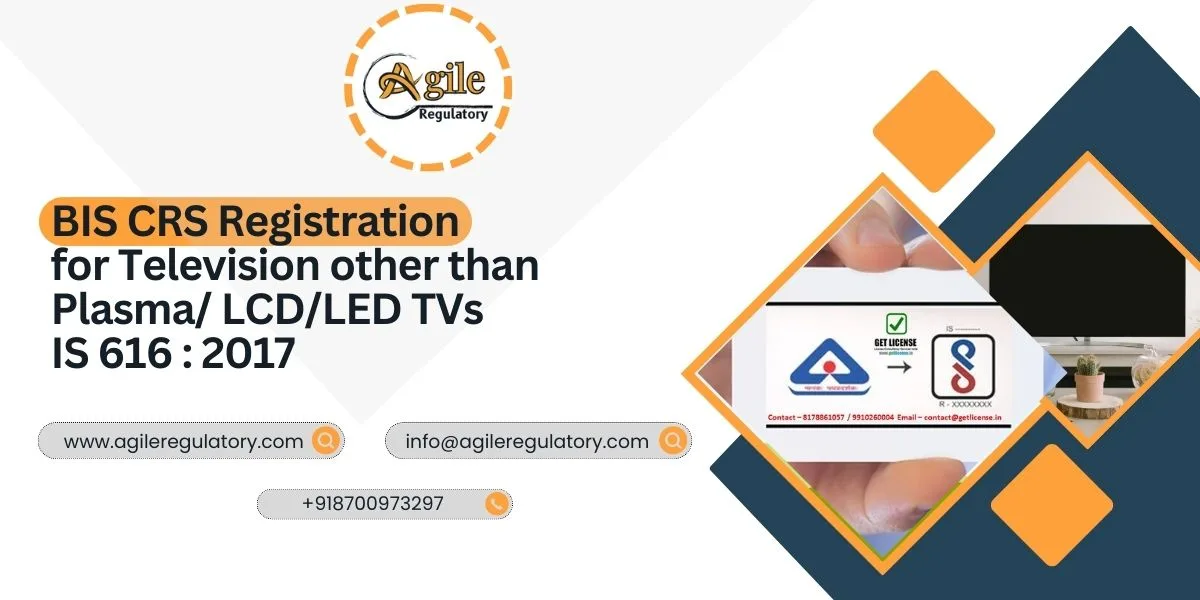
BIS CRS Registration for Television other than Plasma/ LCD/ LED TVs IS 616: 2017
Page Contents (6)
If you’re thinking of bringing in or selling televisions in India that are not Plasma, LCD or LED, there’s a compliance step you cannot skip BIS CRS registration under IS 616:2017. This isn’t a suggestion or a box to tick at your convenience. It’s a legal requirement before you can sell or distribute such TVs in the Indian market
What Exactly Is Covered Here?
When the standard says “Television other than Plasma/LCD/LED,” it primarily refers to older or different display technologies. That typically includes:
- CRT TVs (Cathode Ray Tube)
- Front projector TVs (when sold as complete units)
- Other display types that are not common flat panels
If you are dealing with any of these products, you cannot assume they are exempt from compliance just because they are old-school technology.
Any television set that plugs into power and uses electrical or electronic circuitry must meet safety norms. That’s where BIS comes in.
What Is BIS CRS Registration Anyway?
Under CRS, certain electrical and electronic products have to be registered with BIS before they can be marketed in India. Digital cameras, mobile phones, microwave ovens — all those come under their respective standards. Likewise, non-Plasma/LCD/LED televisions fall under IS 616:2017 for safety compliance.
Once you get registered:
- You get a CRS licence number
- You can use the Standard Mark on your product
- You can sell your units legally in Indian markets
If you skip this — even for one unit — customs and regulators can stop you.
Get Free Consultation!
Why This Registration Is Not Optional
Some businesses assume that out-of-date technologies are not regulated — that they are “too old” to need certificates. That’s a misconception.
The law doesn’t make exceptions based on popularity. The test is very simple:
Is the product electrical/electronic and meant for Indian consumers?
If yes, it needs compliance.
The reasons for this are not arbitrary:
- Safety of end users (no shocks, no fires)
- Preventing substandard or dangerous imports
- Standardising quality across brands and sellers
A television set is an electrical appliance. It connects to a wall socket, and it must be safe. That’s the core idea behind CRS.
Who Needs to Register Under This Scheme
You need BIS CRS registration if you are:
- Importing these TVs into India
- Manufacturing them (even if local components are used)
- Assembling them in India from imported parts
- Selling them under your own brand
If you are just a reseller with valid distribution rights but the product is not registered, that doesn’t help. The product must already have a valid BIS registration before you sell.
If the product is manufactured overseas, the brand owner or manufacturer must appoint an Authorised Indian Representative (AIR) for the BIS process.
Step-by-Step — What You Must Do
Here’s how the CRS registration process practically works:
Step 1: Confirm Your Product Standard
First, make sure your product indeed falls under IS 616:2017. This is the Indian standard for safety of electrical appliances like televisions.
The standard does not test picture quality or audio quality. It tests safety aspects — insulation, wiring quality, protection against electric shock, internal wiring and similar checks
This step is often missed by first-time applicants and it derails the whole application
Step 2: Get Your Sample Tested
To register, you need a test report from a lab that BIS recognises. You cannot use a certificate from just any lab.
The testing lab must execute tests as per IS 616:2017, then issue a compliant report.
Note this — the report’s product details, brand name, and model number must exactly match what you plan to register.
If you submit a wrong test report your application will just bounce back
Step 3: Prepare Your Documentation
Before you start filling forms, ensure you have:
- Test report from a recognised lab
- Product specification sheets
- User manual
- Brand & model details
- Import documentation (if imported)
- Manufacturing address (if locally made)
Mix-ups in model names or versions are frequent reasons for delays. Double-check every line.
Step 4: Log In and Submit Online
BIS has an online portal for CRS registration. You must:
- Create an account
- Input product details carefully
- Upload all documents
- Pay the registration fees
One common mistake is uploading unclear scans or incorrectly named files. Take your time here. It isn’t a race.
Step 5: Respond to BIS Clarifications
After submission, BIS may ask for clarifications or corrections.
Don’t ignore these requests. Reply promptly.
Delays in responses slow your registration unnecessarily.
Once the review is complete and everything is in order, BIS issues the CRS registration certificate.
That’s when your product becomes legally compliant and ready for the Indian market.
Conclusion
If you want to sell or import televisions other than Plasma/LCD/LED — meaning CRT or similar tech — in India, you cannot do it without BIS CRS registration under IS 616:2017.
This process is about user safety and legal compliance. It may seem tedious at first, but it protects you and your customers.
If you want help navigating this correctly without repeated mistakes or delays, Agile Regulatory can assist you from start to finish — from test lab coordination to document preparation and final submission to BIS.
Get your product compliant the right way. Reach out to Agile Regulatory and let them handle your BIS CRS registration so you can focus on growing your business.

About the Author
View ProfileNishi Chawla
Content Writer & Compliance Specialist
Nishi is an expert content writer with expertise in Business Legal Compliances, Certifications, and Registrations — BIS, EPR, Medical Devices, Cosmetics, Drugs, and Import Export. She holds a B.Com from the University of Delhi and has been writing industry content since 2019.