Complete Guide to BIS CRS Registration for Wireless Microphone
Page Contents (6)
If you are planning to import or sell wireless microphones in India then you must understand the BIS Compulsory Registration Scheme (CRS) and how it applies to your product. Wireless microphones are not exempt from certification. The law says that without BIS CRS registration, you cannot legally put them in the Indian market.
This article explains the registration process, requirements, and what you need to do — in simple terms, as if I’m talking to you in a room.
Non-Basmati Rice Exports from India in 2026 with APEDA Registration
What Is BIS CRS Registration?
Let me start with the basics.
The Bureau of Indian Standards (BIS) runs something called the Compulsory Registration Scheme. Certain electronic and IT products are covered under this rule and wireless microphones are one of them. What this means is:
- You cannot sell a wireless microphone in India unless it is registered with BIS.
- The product must be tested for safety and compliance.
- Once approved, you can use the BIS standard mark on the product and packaging.
Why Wireless Microphones Are Listed
You may ask, “Why do microphones need this?” After all, they don’t look like major devices.
Here’s the thing — wireless microphones operate using radio frequencies. They have electronic circuits. They plug into power systems or batteries.
The law looks at electrical safety, radio frequency emissions, and user protection.
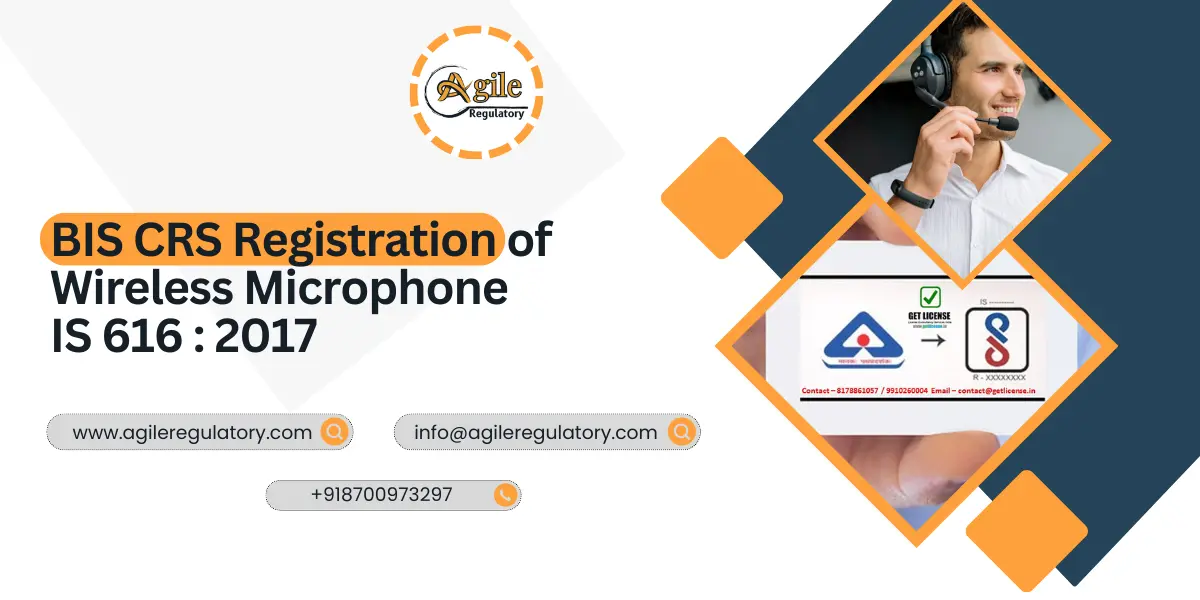
IS 616:2017 is the relevant standard for audio and video electronic equipment. Wireless microphones fall under this category. So if your product is wireless and it handles electronic signals it must conform to safety norms
Get Free Consultation!
IS 616:2017 — What It Covers?
The full title of the standard is a mouthful, but what it means in practice is this:
Your wireless microphone must be tested for:
- Electrical safety — does it protect the user from shocks?
- Circuit insulation — are components safe?
- Internal wiring — does it meet safety standards?
- Interface connections — are they safe when plugged or unplugged?
- Other risk points — sharp edges or exposed wiring
Notice that this is not about audio quality or performance. This is safety compliance, plain and simple.
If a product fails these safety parameters, then even if it works perfectly well as a sound device, BIS will not register it.
Who Must Get BIS CRS Registration
The requirement applies to you if you are:
- Importing wireless microphones into India
- Manufacturing them in India
- Selling them under your own brand
- Distributing them through retail or online channels
Even if you are a small retailer importing a batch for resale, you must ensure the product has BIS CRS registration. If not, customs will block your shipment.
If you are representing a foreign brand, you must appoint an Authorised Indian Representative (AIR) to file and manage the registration.
What the Registration Process Looks Like
I’ll walk you through the main steps. There are six of them, roughly.
1. Confirm the Product Category
First, make sure your product falls under IS 616:2017. That’s the standard BIS uses for wireless microphones. If you misclassify it under something else, your application will fail.
This step sounds obvious, but many newcomers get it wrong.
2. Testing in a BIS-Recognised Lab
You must get samples of your wireless microphone tested in a lab that is recognised by BIS. This is not optional.
The lab will check electrical safety, and then issue a test report showing compliance with IS 616:2017.
Keep multiple samples. Do not send your only inventory to testing. You may need backups.
3. Prepare Your Documents
For the BIS CRS application, you will need:
- Test report from the lab
- Product specification sheets
- Brand name and model details
- User manual copy
- Import documents (if applicable)
- Manufacturing address and details
Everything must match — model, brand, specs. Any mismatch leads to rejection.
One spelling error in a model number can delay your approval.
4. Submit the Application Online
BIS has an online portal for CRS registration.
You will:
- Create an account
- Choose “Wireless Microphone” as the product
- Upload documents
- Pay fees
Take care when uploading files. Wrong formats or oversized PDFs can hold up your application.
5. BIS Reviews and Questions
Once you submit, BIS may ask questions or clarifications. This is normal.
For example:
- “Your test report date is older than 6 months. Update it.”
- “Your labeling does not match the submitted specification.”
Be ready to respond quickly. Delays from your side slow down the whole process.
6. Registration Certificate Is Issued
If everything looks good, BIS issues the CRS Registration Certificate.
This certificate allows you to legally market and sell your wireless microphone in India.
You must then label your product with the BIS standard mark with the registration number.
No mark = no legal sale.
Conclusion
If you want to sell or import wireless microphones in India, you cannot bypass BIS CRS registration under IS 616:2017.
The process is not impossible. But it is detailed, and small errors cost you time and business.
If you want this done properly — without repeated rejections, delays, or confusion — Agile Regulatory can guide you every step of the way. From helping with lab test coordination to preparing your application and managing follow-ups on the BIS portal we take the burden off your shoulders.
Get registered correctly the first time. Reach out to Agile Regulatory and let them handle your BIS CRS registration, so you can focus on your business.

About the Author
View ProfileNishi Chawla
Content Writer & Compliance Specialist
Nishi is an expert content writer with expertise in Business Legal Compliances, Certifications, and Registrations — BIS, EPR, Medical Devices, Cosmetics, Drugs, and Import Export. She holds a B.Com from the University of Delhi and has been writing industry content since 2019.