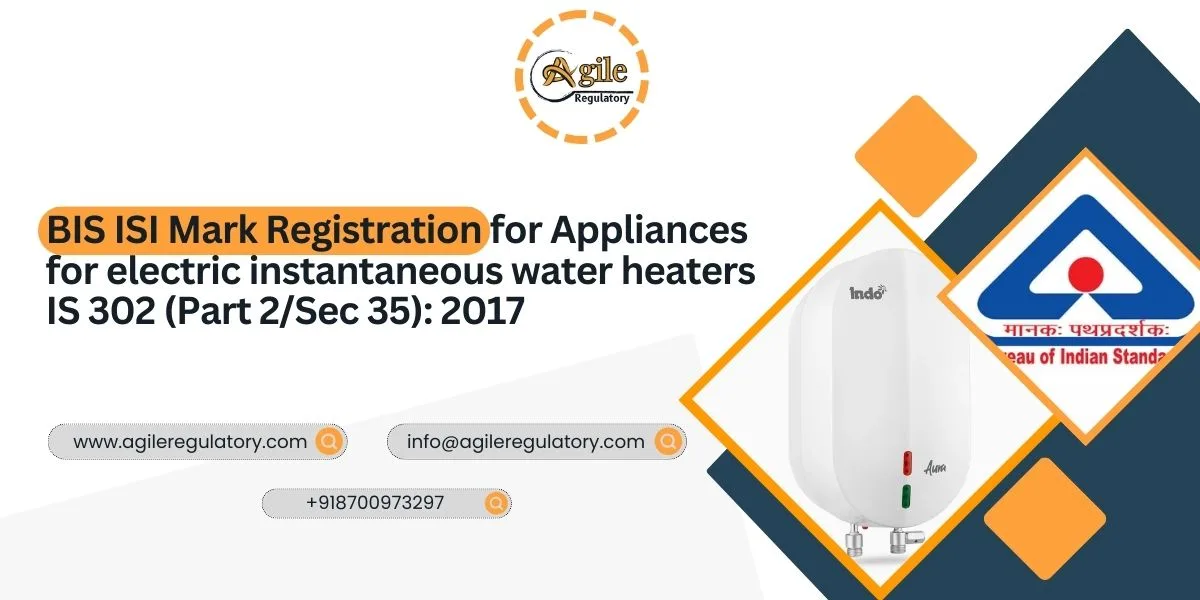
BIS ISI Mark Registration for Appliances for electric instantaneous water heaters IS 302 (Part 2/Sec 35): 2017
Page Contents (4)
If you manufacture, import, sell or plan to offer electric instantaneous water heaters in India you need a clear grasp of the Bureau of Indian Standards (BIS) regulatory process. These heaters devices that heat water the moment it flows through them are no longer just quality-checked products. They fall under a compulsory certification regime imposed by the Indian government. Anyone putting such heaters into the Indian market must obtain the ISI mark based on the Indian Standard IS 302 (Part 2/Sec 35): 2017
What IS 302 (Part 2/Sec 35): 2017 Means for Your Products?
IS 302 (Part 2/Sec 35): 2017 is a specific section of the broader safety standard for household electrical appliances. It focuses on electric instantaneous water heaters heaters that deliver hot water instantly without a storage tank and operate at standard household voltages
This standard defines the criteria these heaters must meet to be considered safe and reliable within homes. These criteria include electrical safety (such as insulation and protection against leakage), mechanical robustness, thermal performance and protect against hazards.
Why BIS Certification and the ISI Mark Are Mandatory?
India’s Electrical Appliances for Domestic Water Heating Quality Control Order (QCO) names electric instantaneous water heaters among the products that must carry the ISI mark under BIS licensing before they can be sold domestically
The Quality Control Order which covers several water heater standards including IS 302 (Part 2/Sec 35): 2017 is issued under the Bureau of Indian Standards Act, 2016. It came into effect for most manufacturers and suppliers starting March 1, 2025 with staggered compliance dates for small and micro enterprises
The BIS ISI mark does three key things:
- Confirms that the appliance conforms to the relevant Indian standard
- Signals to regulators, customers and downstream partners that safety and performance criteria are met
- Makes your product legally admissible for sale in India.
Get Free Consultation!
The Steps to Register and Get the BIS ISI Mark
Getting BIS certification for your electric instantaneous water heater involves multiple stages
Step 1 Confirm the Applicable Standard
Start by confirming that your product falls under IS 302 (Part 2/Sec 35): 2017. The BIS portal and official product manuals outline the exact scope of this standard. Appliances that fall into this category are those used domestically to heat water instantly not storage heaters, not immersion rods.
Step 2 Assemble Documentation
Before engaging with BIS, gather all essential documents related to your company and your product. You will usually need:
- Business identification documents
- Factory or facility registration
- Detailed product specifications
- Drawings, materials lists, and electrical diagrams
- Quality assurance manuals and processes
- Records of in-house testing and product validation
Well-organised documentation speeds up the certification review and supports your readiness for subsequent testing and inspections.
Step 3 Submit the BIS Application
You file your application through the BIS online portal, selecting the Product Certification Scheme-I for mandatory ISI mark products. Along with the standard form, you upload documents and pay the prescribed fees. Scheme-I applies to products under the Quality Control Order requiring conformity assessment.
Step 4 Laboratory Testing
BIS requires product samples to be tested in laboratories that are recognised or accredited by BIS. These tests are not optional. They validate whether your heater meets IS 302-2-35 safety parameters: electrical strength, leakage currents, thermal stability, and other requirements defined within the standard.
Testing must be thorough. Results feed directly into your certification application.
Step 5 On-Site Factory Inspection
BIS officials will schedule a factory inspection. This is not a cursory tour. Inspectors will review your manufacturing processes, quality control systems, testing capabilities and product traceability. If your factory is not prepared they may request corrective measures before issuing a licence
A verified quality system often shortens the time it takes to secure the ISI mark
Step 6 Grant of BIS Licence and ISI Mark Usage
If product tests and factory inspections are successful, BIS grants you a BIS licence specifically for electric instantaneous water heaters under IS 302 (Part 2/Sec 35): 2017. With that licence, you are authorised to affix the ISI mark to compliant products. This mark can appear on the product, packaging and related documentation
Step 7 Surveillance and Renewal
BIS periodically conducts surveillance activities. This includes drawing samples from the market or conducting an unannounced inspection. You must maintain product standards consistently to retain your licence. Renewal is required at specified intervals as outlined by BIS regulations.
BIS ISI Mark Registration for Electric Immersion Water Heaters IS 368: 2014
Conclusion
If your business makes or imports appliances designed for on-demand water heating you cannot avoid BIS certification under IS 302 (Part 2/Sec 35): 2017. The requirement to use the ISI mark is enforceable and compliance is essential for legal sale in India
Working with a regulatory partner such as Agile Regulatory can help ensure that technical requirements, testing obligations, application documentation and inspection readiness are precisely handled.

About the Author
View ProfileNishi Chawla
Content Writer & Compliance Specialist
Nishi is an expert content writer with expertise in Business Legal Compliances, Certifications, and Registrations — BIS, EPR, Medical Devices, Cosmetics, Drugs, and Import Export. She holds a B.Com from the University of Delhi and has been writing industry content since 2019.