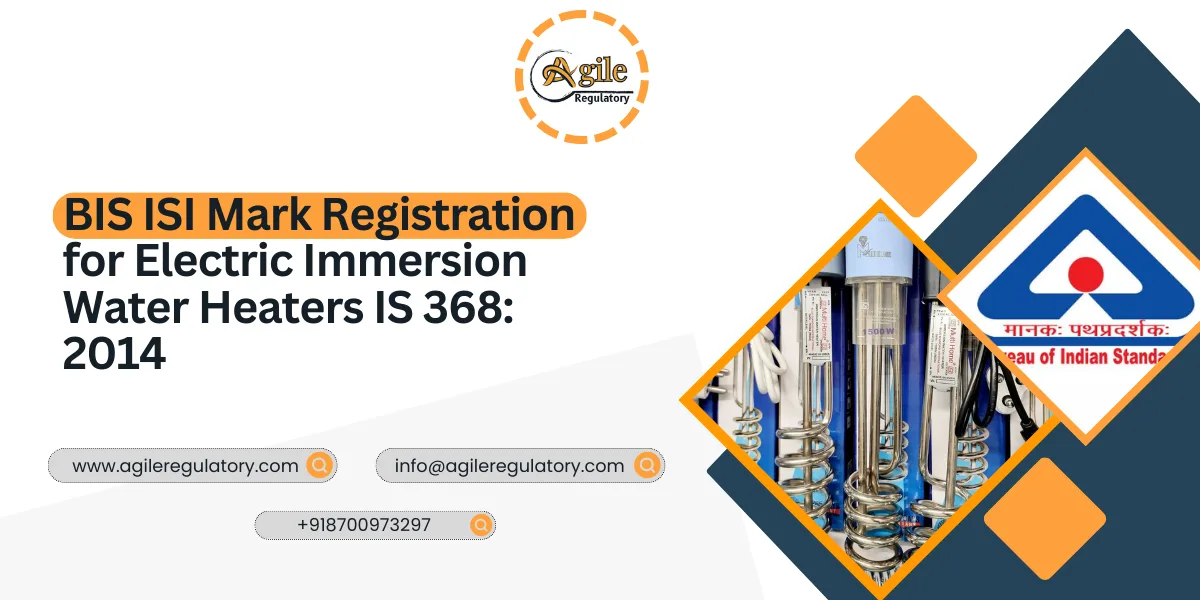
BIS ISI Mark Registration for Electric Immersion Water Heaters IS 368: 2014
Page Contents (5)
If you manufacture or import electric immersion water heaters in India, you are dealing with a regulated product. Not loosely regulated. Not “recommended standard” regulation. Mandatory regulation.
You cannot legally sell an electric immersion water heater in India unless it complies with IS 368:2014 and carries a valid ISI mark issued by the Bureau of Indian Standards (BIS)
This is not branding. It is not marketing. It is statutory compliance.
If you skip it, your product can be seized. Your inventory can be blocked. Your license can be denied. That is the reality under the BIS Act, 2016, and the applicable Quality Control Order covering domestic electric water heating appliances.
Let’s break this down clearly so you understand what applies to you and how the process actually works
First: Does IS 368:2014 Apply to Your Product?
IS 368:2014 specifically covers electric immersion water heaters, the portable rod-type heating devices that are directly immersed into water for heating purposes.
These are typically:
- AC-powered
- Fitted with flexible cords
- Designed for direct immersion use
- Intended for domestic water heating
The standard defines safety parameters like
- Protection against electric shock
- Insulation resistance
- Earthing requirements
- Leakage current limits
- Heating element durability
- Mechanical strength
- Marking and labelling requirements
If you are manufacturing immersion rods for sale in India, this standard applies to you.
The relevant Quality Control Order issued by the Government of India makes BIS certification mandatory for specified domestic electrical appliances, including immersion water heaters
This means:
- You cannot manufacture for the Indian market without a BIS license.
- You cannot import these products into India without certification.
- You cannot affix the ISI mark unless BIS has formally granted you a license number
Only products manufactured under a valid BIS license can bear the ISI mark corresponding to IS 368:2014
Export-only production may be exempt if the goods are not sold domestically. But the moment the product enters the Indian retail chain, certification becomes compulsory.
What the ISI Mark Actually Represents
The ISI mark is not just a logo.
It indicates that:
- Your product has been tested against IS 368:2014.
- Your manufacturing facility has been inspected.
- Your quality control process has been reviewed.
- BIS has granted you a license under Scheme-I certification.
It is tied to your factory, not just the product model. That distinction matters.
You are not simply getting a test report. You are getting permission to use the mark subject to continued surveillance.
Get Free Consultation!
The Real BIS ISI Mark Registration Process
Here’s what the process looks like when done correctly.
1. Confirm Standard Applicability
Before filing anything, you verify that your product category falls strictly under IS 368:2014 and not another IS standard for water-heating appliances. Misclassification causes delays.
2. Prepare Technical Documentation
BIS will expect structured documentation, including:
- Factory registration documents
- Manufacturing process flow
- Raw material specifications
- In-house quality control procedures
- Product drawings
- Bill of materials
- Test equipment calibration records
If your documentation is weak, your inspection will not go smoothly.
3. Product Testing
Samples must be tested in a BIS-recognized laboratory.
The lab evaluates compliance with IS 368:2014 performance and safety parameters. This includes:
- Electrical safety tests
- Insulation resistance
- Leakage current testing
- Temperature rise
- Mechanical strength
- Marking compliance
If your product fails testing you must rectify and re-test
4. Online Application Filing.
Applications are submitted through the BIS portal under Product Certification Scheme-I.
You will upload documents, test reports, factory details and pay applicable fees
Accuracy matters. Even small inconsistencies between your test sample and production description can cause scrutiny
5. Factory Inspection by BIS.
BIS officers conduct an on-site inspection of your manufacturing unit. They review:
- Production capability
- Quality control system
- Testing infrastructure
- Record maintenance
- Sample traceability
If your factory is not inspection-ready, certification can be delayed
6. Grant of License
If testing and inspection are satisfactory, BIS grants a license number.
You are then authorized to mark your immersion water heaters with the ISI logo and the relevant IS number.
Only after this stage can you legally market your product in India
BEE Registration for Electric Geysers or Stationary Storage Type Electric Water Heater
After Certification: What Continues?
Certification is not a one-time event
BIS conducts surveillance inspections. They may draw market samples. They may review your records
You are required to:
- Maintain internal test records
- Ensure batch consistency
- Renew the license as required
- Inform BIS of product modifications
If compliance drops, the license can be suspended.
Conclusion
If you intend to manufacture, import or sell electric immersion water heaters in India BIS ISI certification under IS 368:2014 is a legal requirement, not a branding choice
The process involves testing, inspection, documentation, and ongoing compliance. When done correctly it gives you lawful access to the Indian market and builds product credibility
If you want the process handled carefully and without unnecessary regulatory friction Agile Regulatory provides structured support from documentation preparation to license approval and beyond

About the Author
View ProfileNishi Chawla
Content Writer & Compliance Specialist
Nishi is an expert content writer with expertise in Business Legal Compliances, Certifications, and Registrations — BIS, EPR, Medical Devices, Cosmetics, Drugs, and Import Export. She holds a B.Com from the University of Delhi and has been writing industry content since 2019.