BIS ISI Mark Registration for Fasteners – Drilling Screws with Countersunk Head
Page Contents (7)
Fasteners look simple. To most people, they are just bits of metal with a head and threads. But in engineering and construction, a small fastener failure can cause big problems. India recognises this, and regulators have begun enforcing standards on certain types of fasteners. One such category is cross recessed drilling screws with tapping screw thread — countersunk head.
This product falls under IS 18471 (Part 2): 2023, aligned with international standard ISO 15482:1999. If your organisation manufactures or imports these screws for the Indian market, you need a BIS ISI mark registration before your stock can be legally sold. The consequences of missing this are real — held shipments, rejected orders, and legal exposure.
What Are Countersunk Head Cross Recessed Drilling Screws?
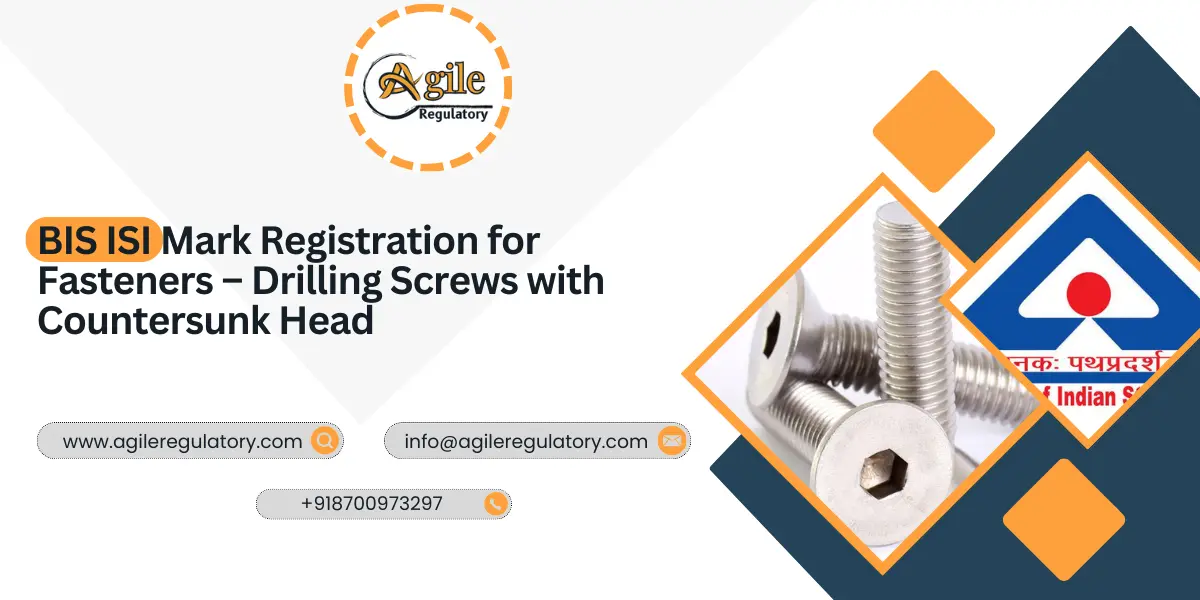
Cross recessed drilling screws with tapping screw thread and a countersunk head are self-drilling, self-tapping fasteners. In practice:
- The drill tip eliminates the pre-drilling stage.
- The tapping thread forms internal threads as it goes in.
- The cross recess allows a Phillips or Pozidriv driver to apply torque
- The countersunk head means the screw sits flush with the surface after installation
This flush profile is important in applications where a protruding head would interfere with moving parts, aesthetics or surface finishes. You will see these screws in metal roofing, cladding, enclosures, factory assemblies and wherever a flat top is required
Poorly made countersunk screws often don’t sit flat, strip easily, or have mismatched drill and thread geometry. These issues are exactly why a standard exists.
What IS 18471 (Part 2): 2023 Specifies
This part of the IS 18471 series defines quality and performance benchmarks that the screws must meet before they can be considered reliable.
The standard covers:
- Head angle and diameter
- Cross recess depth and shape
- Drill point geometry
- Thread profile and pitch accuracy
- Mechanical properties such as torque and tensile strength
- Surface finish and corrosion resistance
This isn’t a casual guideline. The detailed dimensional and performance limits are there because experience shows that even small deviations can lead to installation problems or joint failure over time
Get Free Consultation!
Why BIS ISI Mark Registration Matters?
The Bureau of Indian Standards (BIS) enforces compulsory registration for certain fasteners through a Quality Control Order (QCO). Countersunk head drilling screws are covered.
Once this product is notified, you cannot:
- Sell it in the Indian market
- Distribute it to dealers
- Import it through customs without a valid BIS ISI mark licence.
If you try to bring in unregistered screws, customs can detain the shipment. Retailers and institutional buyers often check for valid licence numbers before accepting goods. There is no workaround — once a product category is notified, all players must comply.
Who Needs to Get the ISI Registration
Compliance obligations fall on:
Domestic manufacturers – If you are making these screws in India, you must apply directly to BIS.
Foreign manufacturers – Screws made outside India still need BIS certification before being imported. A foreign company must appoint an Authorised Indian Representative (AIR) to apply on its behalf.
Importers – Importers must check that the product they are bringing in has a valid ISI licence tied to the manufacturer and model. You can’t just import and register in your own name unless you are the appointed AIR.
The key point is that the licence belongs to the manufacturer, not a random supplier or distributor.
Stages of BIS ISI Registration — Practical View
Getting BIS certified under IS 18471 (Part 2): 2023 takes real preparation. Here’s how it plays out in practice:
1. Documentation Preparation
Before you start, gather:
- Product drawings and specifications
- Quality manual and SOPs
- Marking, packaging plans
- Brand name and trademark details
Labelling and traceability details are important. BIS will want to know how each batch is identified.
2. Product Testing
Samples of your screws go to a BIS-recognised laboratory. They test:
- Head and recess dimensions
- Drill point performance
- Thread accuracy
- Mechanical properties (tensile, torque)
- Surface finish and corrosion resistance
One mistake companies make is using a lab that isn’t officially recognised for all the required tests. Verify the lab’s scope before sending samples.
3. Factory Inspection
BIS inspectors visit the manufacturing unit to check:
- Equipment capability
- Quality control systems
- In-house testing instruments
- Record keeping
The inspectors are detailed. They will check calibration records, non-conformance logs, and how samples are drawn.
4. Licence Issuance
After successful testing and inspection, BIS issues the licence. Now you can use the ISI mark on the screws and packaging.
5. Ongoing Compliance
BIS does not just issue licences and disappear. There are periodic inspections and market sample checks. Keeping records organized helps during these follow-ups.
BIS CRS Registration of Webcam (Finished Product) IS 616: 2017
Common Practical Challenges
From experience, the same issues tend to delay approvals:
- Late lab reports – timing matters because test reports expire.
- Documentation mismatch – what’s on paper must match the sample.
- Poor traceability – inspectors want clear batch and marking records.
- Wrong lab choice – not every lab is recognised for every parameter.
Being meticulous from day one saves weeks of back-and-forth later.
Final Words
Getting the ISI mark is not just about satisfying a rule. It tells buyers that the product meets defined quality and performance standards. In sectors like construction, infrastructure, and OEM assembly, that’s a selling point. No one wants unexpected failures because of inconsistent fasteners. Get expert help from Agile Regulatory today and meet compliance with ease.

About the Author
View ProfileNishi Chawla
Content Writer & Compliance Specialist
Nishi is an expert content writer with expertise in Business Legal Compliances, Certifications, and Registrations — BIS, EPR, Medical Devices, Cosmetics, Drugs, and Import Export. She holds a B.Com from the University of Delhi and has been writing industry content since 2019.