BIS ISI Registration for Hexagon Washer Head Drilling Screws (IS 18476)
Page Contents (7)
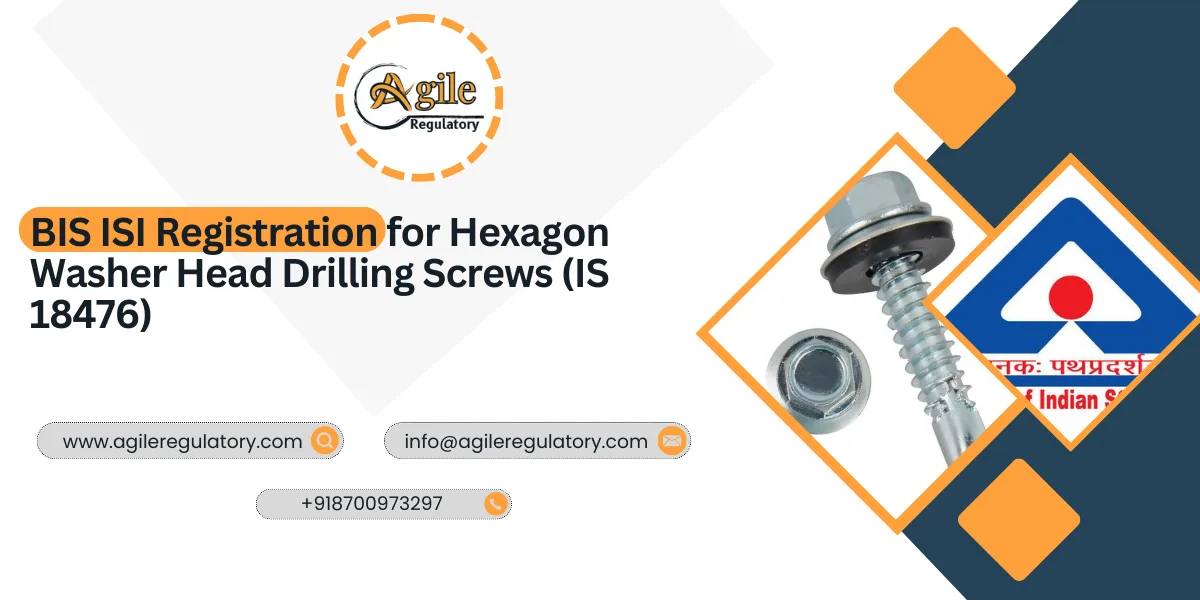
Fasteners might seem like simple commodity items, but regulators see them differently—especially when they are used in structural or load-bearing applications. Among these, hexagon washer head drilling screws with tapping screw threads have recently been brought under formal Indian standards. Compliance is no longer optional; if your product falls under this scope, it must be BIS-certified before it can be sold or imported in India.
What Are Hexagon Washer Head Drilling Screws?
At a glance, these screws look familiar to anyone who works with mechanical assemblies.
They are distinctive because:
- They have a hexagon head with an integrated washer (helps distribute load)
- The head is meant for tightening with a wrench or socket
- They drill their own hole and form threads as they’re driven in
- This eliminates the need for pre-drilling and tapping in many metal applications
These screws are widely used in:
- Structural metal assemblies
- Building and roofing systems
- Automotive bodies and sub-assemblies
- Heavy-duty furniture and fixtures
The hex washer design gives better clamping and torque control than simple pan or countersunk heads. Because they are often driven into thin sheet materials, any poor design or manufacture can lead to stripped threads or weak fastening. The new Indian standard exists to prevent exactly those kinds of field failures.
IS 18476: 2023 – What This Standard Specifies
IS 18476: 2023 is the Indian standard that sets the rules for these fasteners. It is harmonised with ISO 15480:2019, so products conforming to it should also align with international expectations.
The standard addresses the following:
- Head shape and dimensions
- Washer geometry and how it mates with the head
- Drill point design to ensure penetration without pre-drilling
- Thread profile, pitch, and engagement
- Material quality and mechanical strength
- Torque resistance and corrosion resistance
Each of these characteristics has defined limits and tolerances. If a screw falls outside them, it might still hold in a bench test—but it won’t meet the IS standard and so cannot be legally sold with the ISI mark.
ISO 15480:2019 serves as the international reference, and the Indian standard remains consistent with it so firms that already produce to ISO practice get fewer surprises.
Get Free Consultation!
Mandatory BIS ISI Mark: What It Means
India’s Quality Control Orders (QCO) have brought a range of fasteners under mandatory BIS certification. Hexagon washer head drilling screws are among them. Once a product is notified under a QCO:
- It must bear the ISI mark
- Sales and imports without the mark are considered non-compliant
- Non-compliance can lead to stock being seized, fines, or refusal of entry at ports
The intent of the QCO is not to make life difficult for industry but to ensure that products entering the Indian supply chain are consistent, measurable, and safe. Fasteners, especially ones that drill and tap, are subjected to real stresses in the field. Poor quality here isn’t a minor defect—it can cause structural failure.
Who Must Get BIS Certification?
If you are in this product category, you need certification before selling or importing:
- Domestic manufacturers of these screws
- Foreign manufacturers exporting to India
- Importers who bring these screws into India
Foreign manufacturers are required to appoint an Authorised Indian Representative (AIR). This person or company acts as the legal liaison with BIS. In practice, choosing a weak or unreliable AIR creates headaches during inspections and testing, so it pays to select one with experience.
How the BIS Certification Process Works
BIS certification isn’t just a form-filling exercise. It involves real testing and factory verification.
Here’s roughly how it goes:
Application Submission
The manufacturer or AIR submits specifications, drawings, and other product details.
Product Testing
Samples are tested in a BIS-recognised laboratory for:
- Dimensions and tolerances
- Mechanical strength (tensile, torque)
- Corrosion resistance
- Thread integrity
Factory Inspection
BIS officials verify whether:
- Quality control systems are in place
- Testing facilities within the plant are suitable
- Records are maintained properly
Grant of Licence
Once tests and inspection are satisfactory, BIS issues a licence. This allows the use of the ISI mark on products and packaging
Ongoing Surveillance
BIS periodically revisits facilities and can retest market samples to ensure compliance continues.
Practical Benefits Beyond Compliance.
BIS certification brings several business advantages:
- Better buyer confidence in construction and engineering sectors
- Acceptance in government tenders that require standards compliance
- Reduced product returns and field failures
- Better documentation practices, which help with ISO or export standards.
Final Thoughts.
Registering hexagon washer head drilling screws with BIS under IS 18476:2023 is more than a bureaucratic requirement. It reflects a product’s ability to perform reliably under expected load and environmental conditions. This matters because these screws are often mission-critical in metal and structural assemblies. Quality isn’t subjective here; it is defined in measurable terms that matter in the field. If you need help with registration, get in tuch with experts at Agile Regulatory today!

About the Author
View ProfileNishi Chawla
Content Writer & Compliance Specialist
Nishi is an expert content writer with expertise in Business Legal Compliances, Certifications, and Registrations — BIS, EPR, Medical Devices, Cosmetics, Drugs, and Import Export. She holds a B.Com from the University of Delhi and has been writing industry content since 2019.