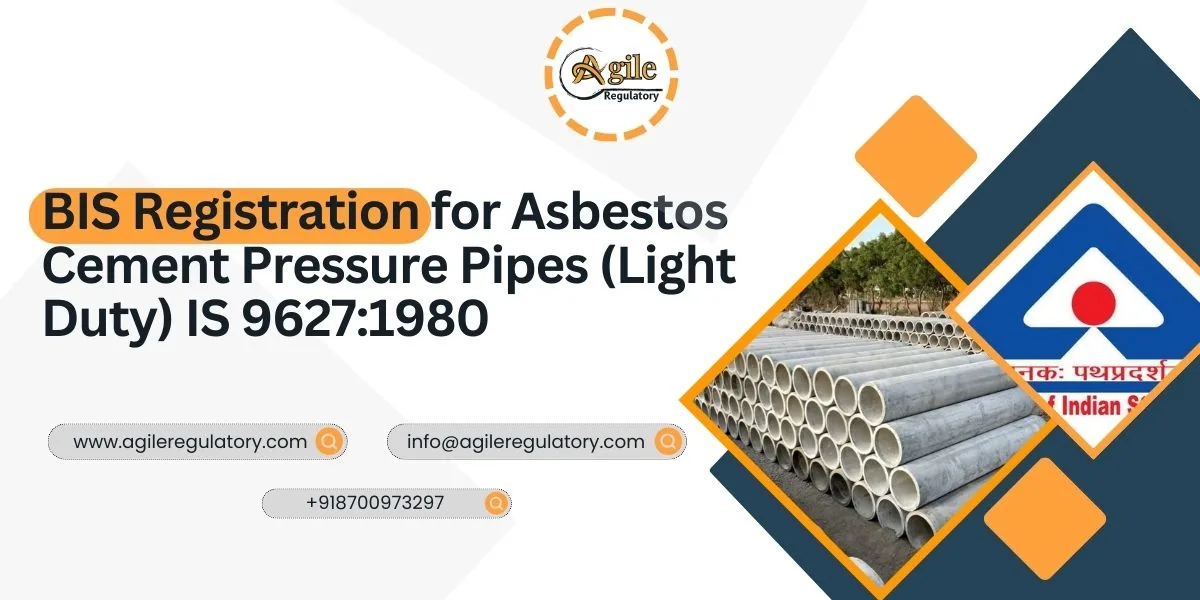
BIS Registration for Asbestos Cement Pressure Pipes (Light Duty) IS 9627:1980
Page Contents (7)
If you are manufacturing asbestos cement pressure pipes for light-duty use, or importing them into India, you cannot treat them like a regular building product anymore.
These pipes are covered under a Quality Control Order issued by the Government of India. That means BIS certification is compulsory. Without it, you cannot legally sell them in the Indian market.
This applies whether you supply to:
- Private contractors
- Irrigation projects
- Municipal water lines
- Distributors
- Government tenders
If the product enters Indian commerce, certification is mandatory.
First, Understand the Standard Itself
IS 9627:1980 lays down the technical requirements for asbestos cement pressure pipes intended for light-duty applications.
The standard covers things like:
- Composition of cement and asbestos fibre
- Manufacturing method
- Wall thickness
- Tolerances
- Hydrostatic pressure testing
- Crushing load
- Bending strength
- Marking details
These pipes are meant to handle internal pressure, even if it is classified as “light duty.” If they fail, you do not just have a product issue. You have infrastructure risk.
That is why the government moved these products under mandatory certification.
Why BIS Certification Is Not Optional
The Asbestos or Fibre Cement Based Products (Quality Control) Order, 2023 was issued under the Bureau of Indian Standards Act, 2016.
Once a product is notified under a Quality Control Order:
- You must obtain a BIS licence.
- You must use the ISI mark.
- You cannot manufacture for sale or import without certification.
If you continue selling without a licence:
- Authorities can seize stock.
- You may face financial penalties.
- Your supply contracts can collapse.
- Enforcement action can follow under the BIS Act.
This is statutory compliance. Not a branding exercise.
BIS Registration for Shallow Corrugated Asbestos Cement Sheets IS 13008:1990
Get Free Consultation!
What You Actually Have To Do
Let’s keep it practical.
1. Confirm the Standard
Make sure your pipe truly falls under IS 9627:1980 (Light Duty). Do not confuse it with other asbestos cement pipe standards. Incorrect classification delays everything.
2. Get the Product Tested Properly
You must send samples to a BIS-recognized laboratory.
Tests generally include:
- Hydraulic pressure test
- Crushing strength
- Dimensional verification
- Mechanical strength tests
BIS will not accept random third-party reports. The lab must be acceptable to them.
3. Prepare Documentation Carefully
You will need:
- Manufacturing process flow
- Raw material details
- Quality control plan
- In-house testing procedures
- Product drawings
- Lab test reports
If your test report says one thickness and your drawing shows another, BIS will raise objections.
Consistency matters.
4. Apply Under Scheme-I
The application is filed online through the BIS system under the ISI Mark Scheme.
You upload documents, pay government fees, and declare production capacity.
5. Be Ready for Factory Inspection
BIS officers may visit your facility.
They check:
- Production line
- Testing equipment
- Record keeping
- Quality control implementation
If your systems exist only on paper, it will show during inspection.
6. Licence Grant
If everything satisfies the regulator, you receive a BIS licence and can mark your pipes with the ISI symbol.
Only after that can you legally sell in India.
Where Things Usually Go Wrong
In real cases, delays happen because:
- Lab testing was done before finalizing product specifications
- Documentation was copied from another product
- Quality control registers were incomplete
- Factory layout did not match application details
- The applicant misunderstood the applicable class
- Each query from BIS adds weeks or months.
If you are already supplying to a project, those delays become expensive.
Why Many Manufacturers Work With Agile Regulatory
Handling BIS registration internally is possible, but it demands precision.
Agile Regulatory works specifically on mandatory BIS registrations, including asbestos cement products.
They help you:
- Identify the correct standard and class
- Structure documentation properly
- Coordinate with recognized laboratories
- Prepare for inspection
- Respond to BIS queries
- Manage licence issuance
The benefit is not just faster filing. It is fewer objections.
When a product is under a Quality Control Order, mistakes are not minor. They affect your ability to operate.
If you want the process handled with regulatory discipline rather than guesswork, working with a specialist helps.
Ask Yourself Before Filing
Be honest with these:
- Are your pipes consistently meeting IS 9627:1980 requirements?
- Do you have valid lab reports from an acceptable laboratory?
- Is your factory inspection-ready today?
- Are your quality records structured and traceable?
- Do you understand that BIS conducts surveillance even after licence grant?
If any answer is uncertain, fix it first.
Final Word
Asbestos Cement Pressure Pipes (Light Duty) under IS 9627:1980 require BIS certification before you can legally sell them in India.
This requirement comes from the Quality Control Order issued under the Bureau of Indian Standards Act, 2016.
You cannot bypass it. You cannot delay it indefinitely. And you should not treat it casually.
If you want structured assistance to obtain BIS registration without regulatory setbacks, Agile Regulatory is a dependable option to consider.
Get certified before you scale supply. It is far easier to comply early than to correct violations later.

About the Author
View ProfileNishi Chawla
Content Writer & Compliance Specialist
Nishi is an expert content writer with expertise in Business Legal Compliances, Certifications, and Registrations — BIS, EPR, Medical Devices, Cosmetics, Drugs, and Import Export. She holds a B.Com from the University of Delhi and has been writing industry content since 2019.