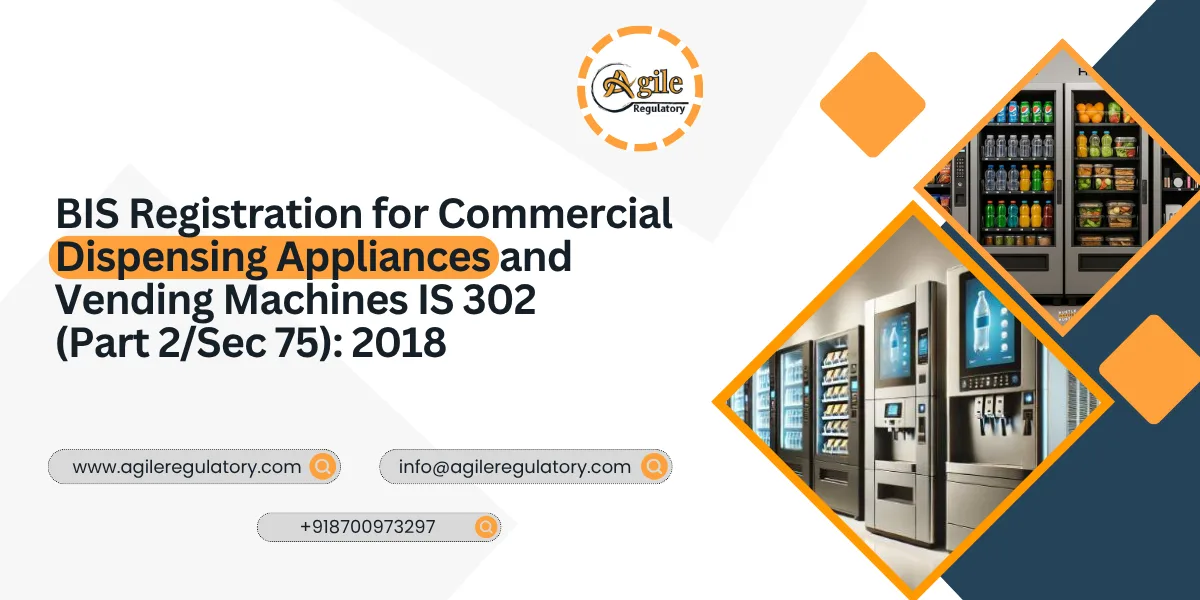
BIS Registration for Commercial Dispensing Appliances and Vending Machines IS 302 (Part 2/Sec 75): 2018
Page Contents (9)
You can design a vending machine that works perfectly in your lab.
It dispenses coffee, mixes ingredients, and handles power fluctuations; everything looks fine.
Then it reaches the market.
And suddenly, you can’t sell it.
Not because it doesn’t work. But because it isn’t certified.
That’s where BIS registration comes in.
If you are manufacturing, importing, or planning to sell commercial dispensing appliances or vending machines in India, you are stepping into a regulated category. And the standard you are dealing with is specific: IS 302 (Part 2/Section 75): 2018.
Ignore it, and your product doesn’t enter the market.
BIS Registration for Medical Devices IS 23485 - Quality Management Systems
What This BIS Standard Actually Covers
IS 302 (Part 2/Section 75): 2018 is not a general guideline.
It is a safety standard for electrical appliances designed for commercial dispensing machines that prepare or dispense beverages or other consumables using electricity.
This includes:
- Coffee vending machines
- Tea dispensing units
- Beverage dispensers
- Automated drink machines used in offices, malls, and commercial spaces
The standard defines how these machines should perform under real conditions, especially in terms of electrical safety and operational stability
It is aligned with international safety principles but adapted for Indian conditions.
Why This Certification Is Mandatory
This is not optional.
Under the Compulsory Registration Scheme (CRS) managed by the Bureau of Indian Standards, certain electrical products must be registered before they can be sold in India.
Commercial dispensing appliances and vending machines fall under this framework when notified.
That means:
- You cannot sell without BIS registration
- You cannot import without approval
- You cannot distribute non-compliant products
The idea is simple: these machines combine electricity, heat, and liquid handling. Any fault can lead to shock hazards, overheating, or fire risks.
So BIS doesn’t just check performance. It checks safety.
Get Free Consultation!
What Exactly Gets Tested Under IS 302 (Part 2/Sec 75)
You’re not submitting your product for a visual inspection.
You’re submitting it for detailed testing.
The evaluation includes:
- Protection against electric shock
- Insulation resistance
- Leakage current
- Heating and temperature rise
- Mechanical strength
- Stability during operation
- Resistance to moisture
Each of these tests is designed to simulate real-world usage.
If your machine overheats under continuous operation or fails insulation tests, certification stops there.
There is no partial approval.
BIS Registration for Asbestos Cement Pressure Pipes and Joints IS 1592:2003
Who Needs BIS Registration for These Machines
You need registration if you are:
- A manufacturer producing vending machines in India
- An importer bringing machines from outside India
- A brand owner selling under your label
Even if your product is manufactured abroad, you still need BIS approval before selling it in India.
In such cases, a local Authorized Indian Representative (AIR) is required.
So the responsibility stays with you, not your supplier.
What You Must Have Before You Apply
This is where most applications slow down.
Before you start the process, check your preparation.
You need:
- A finalized product design
- Technical specifications
- Electrical safety compliance built into the design
- Access to a BIS-recognized testing lab
But there’s one more thing.
Consistency.
Your product must be capable of passing tests repeatedly, not just once.
Because BIS certification is not about a single sample. It’s about your ability to maintain quality.
Documents Required for BIS Registration
The documentation is structured, but it’s not forgiving.
You will need:
- Business registration documents
- Product specifications and technical details
- Test reports from BIS-recognized laboratories
- Brand authorization (if applicable)
- Details of manufacturing unit
- Authorized Indian Representative details (for foreign manufacturers)
Everything must match your product.
If your test report describes a different configuration than your actual machine, the application gets flagged
Step-by-Step BIS Registration Process
The process looks straightforward. But each step depends on the previous one being accurate
You begin by getting your product tested in a BIS-recognized laboratory
This is not optional. Testing is the foundation
Once testing is complete and reports are generated, you submit your application on the BIS portal
After submission:
- BIS reviews your documents
- Verifies test reports
- Checks compliance with IS 302 (Part 2/Sec 75)
If everything is correct registration is granted
If not, you receive queries
And this is where delays begin
Timeline and Validity
There is no fixed timeline, but typically:
- Testing takes a few weeks
- Application review takes additional time depending on accuracy
The process goes faster if your paperwork is complete.
If corrections are needed the timelines get longer
After being approved BIS registration is good for a set amount of time and needs to be renewed
Your product must still meet the same standards during this time.
Conclusion
If you are manufacturing or selling commercial dispensing appliances and vending machines in India, BIS registration under IS 302 (Part 2/Section 75): 2018 is not optional
It is a mandatory requirement tied directly to product safety
The process involves testing, documentation, and compliance verification. It demands preparation
If you want to avoid delays, rejections and repeated submissions, getting the structure right from the beginning matters
Agile Regulatory can help you navigate BIS registration, prepare your application correctly and reduce the chances of rejection so you can focus on launching your product instead of fixing compliance issues

About the Author
View ProfileNishi Chawla
Content Writer & Compliance Specialist
Nishi is an expert content writer with expertise in Business Legal Compliances, Certifications, and Registrations — BIS, EPR, Medical Devices, Cosmetics, Drugs, and Import Export. She holds a B.Com from the University of Delhi and has been writing industry content since 2019.