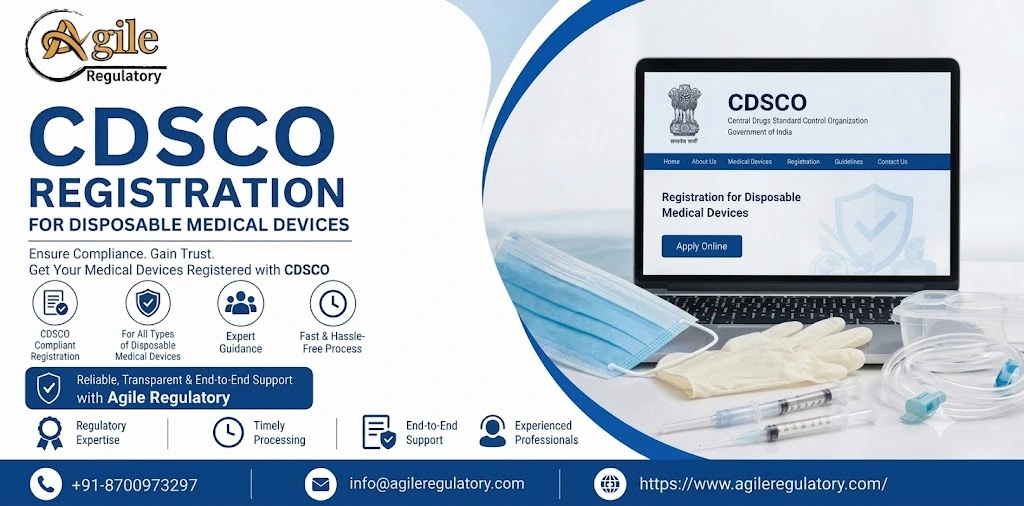
CDSCO Registration Fees in India in 2026: Latest Cost Breakdown
Page Contents (9)
When you start looking into CDSCO registration, one of the first questions that hits you is cost. Not consultancy fees. Not documentation expenses. The government fees. The ones you cannot skip, negotiate, or adjust.
In 2026, CDSCO Registration fees in India continue to depend on what you deal in, how risky your product is, and whether you manufacture locally or import from outside India. What makes it confusing is that there is no single “CDSCO fee.” Every category follows its own rulebook.
This article explains those fees so you know what you are expected to pay and where the numbers come from.
Why CDSCO Fees Exist in the First Place
CDSCO works under the Ministry of Health and Family Welfare. Its job is not to support businesses. Its job is to protect public health. Fees are charged so applications are reviewed properly, facilities are evaluated and compliance is enforced
In simple terms you pay for regulatory oversight
By 2026 CDSCO has become far stricter about fee compliance. If the amount is wrong, if the challan head is incorrect or if the fee does not match your product category, your application will not move forward
Medical Device Registration Fees: How They Are Calculated
Medical devices are regulated under the Medical Device Rules, 2017. Fees depend mainly on risk classification.
If your device falls under Class A or Class B, the government fees are relatively low. For manufacturing licenses, you typically pay a small site fee and an additional amount per product. These amounts remain affordable because these devices pose lower risk.
For Class C and Class D devices, the situation changes. These are higher-risk products. CDSCO charges a significantly higher site fee and a higher per-device fee. This applies whether you are manufacturing in India or applying through central licensing.
For imports, fees increase further. Import licenses are charged per overseas manufacturing site and per product. The higher the risk class, the higher the amount.
These figures are prescribed in official schedules and have not been relaxed in 2026.
Get Free Consultation!
Drug Import and Registration Fees: Where Costs Rise Quickly
If you are importing drugs into India, fees are much higher than many people expect. CDSCO charges separately for registering the manufacturing site and for registering each drug.
For imported pharmaceuticals, you pay a substantial fee just to register the foreign manufacturing premises. On top of that, each drug formulation attracts its own registration fee. If you add more products later, you pay again.
Biologicals and special category drugs follow similar principles but may involve additional approvals.
This structure has not changed in 2026, which is why early budgeting is critical.
Cosmetic Registration Fees: Often Overlooked, Still Mandatory
Cosmetics are regulated under CDSCO for imports and under state authorities for manufacturing. If you import cosmetics, fees are charged in foreign currency.
You pay one fee to register the overseas manufacturing site. Then you pay per cosmetic category. If your product has multiple variants each variant attracts an additional charge.
Inspection fees may apply if CDSCO decides to inspect the foreign facility. These inspection costs are fixed and non-refundable
In 2026 CDSCO continues to enforce cosmetic registration strictly. Products without valid registration are stopped at ports.
Payment Methods and Fee Submission
Most CDSCO fees are paid using a TR-6 challan deposited at designated Bank of Baroda branches in New Delhi. For foreign applicants, electronic remittance options apply.
What matters is not just payment, but payment under the correct Head of Account. Many applications are delayed because the fee was deposited correctly but mapped incorrectly.
Once paid, the challan copy becomes a core part of your application file.
CDSCO Certificate Registration in Delhi: Documents, Process, and Fees
Retention Fees and Why Licenses Are Not “Lifetime”
Another point businesses miss is retention. CDSCO licenses do not remain valid forever without cost. You must pay retention fees periodically, usually every five years.
If you miss retention deadlines, the license can lapse. Restoring it is far more expensive and time-consuming than paying on time
In 2026, CDSCO actively tracks retention compliance through digital systems
Why Fee Errors Are Costly?
- If you underpay, your application is kept pending.
- If you overpay, refunds are rare and slow.
- If you pay under the wrong category, you may need to start again.
These are not theoretical risks. They happen daily.
That is why understanding CDSCO fees is not about saving money. It is about avoiding regulatory waste.
Where Agile Regulatory Fits In
Agile Regulatory does not “guess” fees. They calculate them based on rules, classification, and current CDSCO schedules.
When you work with Agile Regulatory, you are told:
- Which fee applies and why
- Whether your product falls under state or central licensing
- What retention fees you will face later
- How to structure applications to avoid repeated payments
This clarity is why Agile Regulatory is considered one of the most dependable CDSCO consultants in India.
Conclusion
CDSCO registration fees in India are fixed, regulated, and unavoidable. What you can control is how accurately you calculate them and how efficiently you apply
In 2026, guessing is expensive. Precision saves time.
If you want clarity before filing, not corrections after rejection, Agile Regulatory can guide you through CDSCO fee planning and compliance with confidence.

About the Author
View ProfileNishi Chawla
Content Writer & Compliance Specialist
Nishi is an expert content writer with expertise in Business Legal Compliances, Certifications, and Registrations — BIS, EPR, Medical Devices, Cosmetics, Drugs, and Import Export. She holds a B.Com from the University of Delhi and has been writing industry content since 2019.