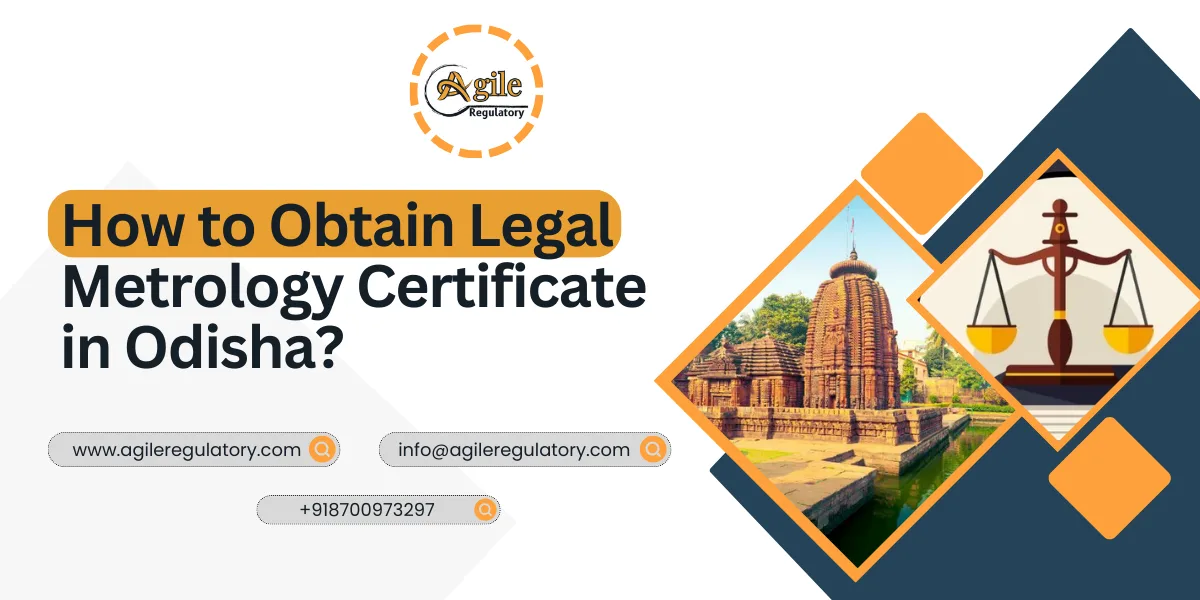
How to Apply for Legal Metrology Certificate in Odisha
Page Contents (10)
Most businesses in Odisha don’t think about legal metrology until someone from the department shows up. That is usually how it starts. An inspection. A notice. A question about a weighing scale, a label or a quantity printed on a package
At that point you realize legal metrology is not optional
If your business uses weights, measures, or measuring instruments or sells goods by quantity, the law expects you to follow the Legal Metrology Act 2009 and the rules enforced by the Odisha Legal Metrology Department. There is no workaround. There is only compliance
This article explains how you actually obtain a Legal Metrology certificate in Odisha not in theory but in practice
What Legal Metrology Covers (And Why It Applies to You)
Legal metrology is about accuracy in trade. That is all. If money changes hands based on weight, measure, volume, or count. The government wants that measurement to be correct.
In Odisha, legal metrology is enforced by the Directorate of Legal Metrology under the Food Supplies and Consumer Welfare Department. Officers are authorised to inspect premises, test instruments and take action if the law is not followed
This applies whether you are running a retail shop, a warehouse, a manufacturing unit or a packaging operation
If you use:
- weighing machines
- measuring instruments
- fuel dispensers
- packaged goods with declared quantities
You are inside the scope of legal metrology.
The “Certificate” Is Not Just One Thing
One reason businesses get confused is because there is no single certificate called “Legal Metrology Certificate” that fits everyone.
In Odisha, you may need one or more of the following, depending on what you do:
- Verification and stamping of weights and measures
- Registration as a dealer, manufacturer, or repairer
- LMPC registration for packaged commodities
People often apply for the wrong thing first. That is where delays begin.
Before doing anything else, you must clearly understand how your business uses measurement.
Everything else flows from that
Get Free Consultation!
How Does the Process Usually Begin in Odisha?
In most cases, the process begins locally.
You approach the Legal Metrology office that has jurisdiction over your business location. For many applicants this means dealing with the Legal Metrology Inspector or Assistant Controller assigned to your district
For central coordination, the Directorate operates from Bhubaneswar, but inspections and verification are handled locally.
You do not start with inspection. You start with preparation
Document Preparation Comes First (Even Before Forms)
This part is rarely explained properly.
Before you submit any application, you must be ready to show:
- who you are
- where your business operates
- what instruments you use
- how those instruments are used in trade
Typical documents include identity proof, address proof, business registration papers, and details of weighing or measuring instruments. If you are dealing with packaged goods, you also need label details.
Inspection Is the Deciding Stage
After your application is accepted, a legal metrology officer schedules an inspection.
This inspection is practical, not theoretical.
The officer checks:
- whether the instruments actually exist
- whether they are in working condition
- whether they match declared specifications
- whether they are suitable for commercial use
If an instrument is portable, it may be tested at the office. If it is fixed or heavy, verification happens at your premises.
If something is wrong, the officer will not approve it “for now.” You are asked to correct it and re-present it.
This step cannot be skipped.
Verification and Stamping: What It Means
When an instrument passes inspection, it is verified and stamped.
The stamp is not decorative. It shows:
- the authority that verified it
- the time period for which it is valid
Using an unstamped or expired instrument in trade is a violation, even if the instrument is accurate.
After stamping, you receive a verification certificate. This certificate must be preserved and produced during inspections.
What Happens After Certification
Once verification and required registrations are complete, your legal metrology compliance is considered active.
But compliance does not end there.
Instruments must be re-verified periodically. Licenses and registrations must be renewed in time. New instruments must be declared and verified before use.
Most penalties happen not because businesses never complied but because they stopped paying attention after the first certificate
Legal Metrology (LMPC) Certificate Registration in Maharashtra
Common Mistakes Businesses Make
These issues appear again and again:
- applying after receiving a notice
- using instruments before verification
- ignoring renewal timelines
- assuming one certificate covers all activities
None of these mistakes are complicated. They happen due to lack of clarity.
Why Businesses Prefer Professional Support
You can manage legal metrology compliance on your own. Many try. Some succeed. Many do not.
The problem is not intelligence. The problem is interpretation.
Agile Regulatory works with the rules as they are enforced, not just as they are written. They help you identify exactly what applies to your business in Odisha prepare documentation that stands inspection scrutiny and manage renewals so compliance does not lapse quietly
That is why Agile Regulatory is often chosen as the preferred support partner for legal metrology matters.
Conclusion
Legal Metrology certification in Odisha is not something you handle after operations begin. It is something you plan for before inspections force your hand.
If you want clarity, correct classification, and smooth verification, working with Agile Regulatory helps you move through the legal metrology process without confusion or repeated visits.
Start compliance on your terms, not after enforcement begins.

About the Author
View ProfileNishi Chawla
Content Writer & Compliance Specialist
Nishi is an expert content writer with expertise in Business Legal Compliances, Certifications, and Registrations — BIS, EPR, Medical Devices, Cosmetics, Drugs, and Import Export. She holds a B.Com from the University of Delhi and has been writing industry content since 2019.