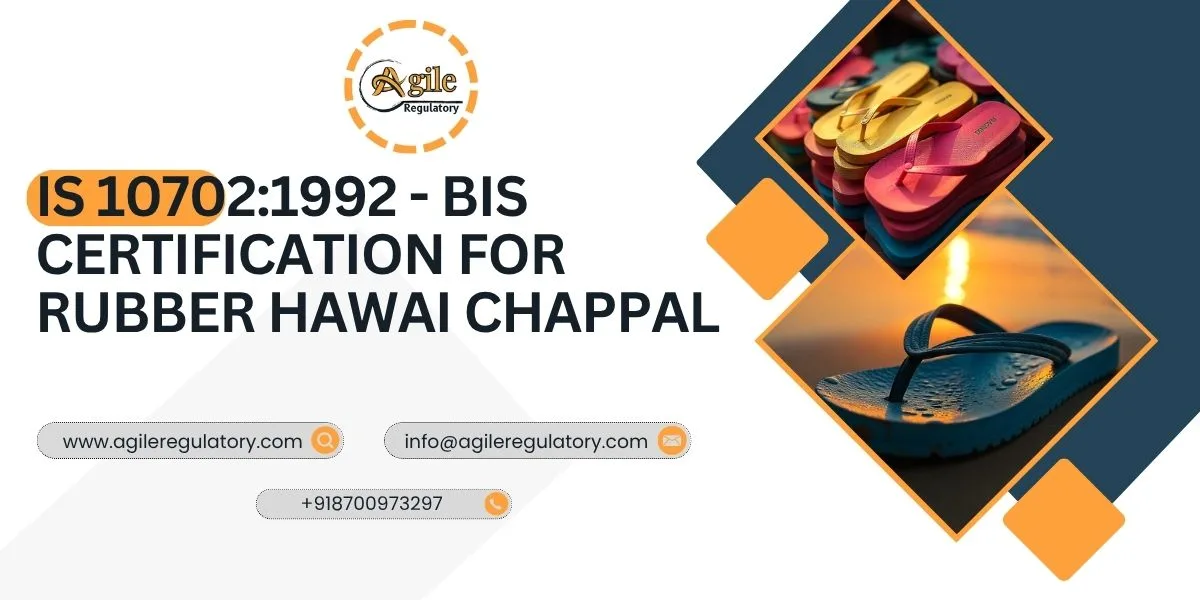
IS 10702:1992 BIS Certification for Footwear (Hawai Chappal): Complete Guide
Page Contents (10)
The BIS Certification under IS 10702:1992 applies to Rubber Hawai Chappals. It is the basic open footwear made of natural or synthetic rubber. These chappals are simple, durable and widely used in homes, shops and public areas across India. The Bureau of Indian Standards (BIS) has made it mandatory for manufacturers to follow specific quality rules for these chappals to ensure strength, comfort and consumer safety
To sell or export these chappals in India getting a BIS license is now necessary. If a business skips this step its products can be marked as non-compliant. In Delhi, Mumbai or any other city this rule applies the same
Why Is BIS IS 10702:1992 Important?
BIS Certification for IS 10702:1992 helps protect buyers from poor-quality footwear. These chappals must meet certain test conditions:
- Tear strength
- Sole adhesion
- Strap durability
- Shape retention
When a brand carries the ISI mark, it tells buyers that the chappal passed a government-approved quality check. No mark means no trust, especially in bulk or government tenders. It also gives legal protection and boosts market value.
Who Needs This Certification?
The BIS IS 10702:1992 certification is necessary for:
- Manufacturers of rubber Hawai chappals in India
- Foreign producers who export to India
- Small-scale units aiming for retail or e-commerce sales
- Bulk suppliers selling to schools or state projects
If you make, brand, or even pack these chappals, you need a valid BIS license.
Get Free Consultation!
Documents Required for BIS IS 10702
To apply for this license, the producer needs to submit certain paperwork
For Indian Manufacturers
- Copy of factory registration
- GST certificate
- Address proof of premises
- Manufacturing process flowchart
- Product layout and drawing
- In-house lab equipment list
- Test report (if available)
- Packaging label sample
- Authorized person’s ID
For Foreign Manufacturers (FMCS route)
- Factory registration in the home country
- Company profile
- Details of Authorized Indian Representative (AIR)
- Proof of production capacity
- Trademark authorization (if any)
Documents must be accurate and up to date. Even a single missing paper can delay the process.
IS 2062:2011 - BIS Certification for Hot rolled medium and high tensile structural steel
Step-by-Step BIS Certification Process
The BIS IS 10702:1992 registration goes through these steps:
Step 1 – Check Standard and Product Readiness
The chappal should follow IS 10702:1992 rules. That means the raw material, production tools, and quality checks must be ready in the factory.
Step 2 – Prepare Documents
The producer or agent gathers all factory papers, lab setup info, and sample packaging material.
Step 3 – Submit Application
BIS has an online portal to file the application. Each detail must match the factory data and uploaded papers.
Step 4 – Factory Inspection
Your factory is checked by an inspection officer send by BIS. They verify machines, lab tools, hygiene, and testing methods.
Step 5 – Product Testing in BIS-Approved Lab
Sample chappals are taken during the factory visit. These are tested in an authorized lab. Reports are uploaded to the portal.
Step 6 – Grant of ISI License
If the lab report clears all tests and documents match, BIS grants the certificate. The ISI mark must be printed on each product.
Testing Requirements for IS 10702:1992
The IS 10702:1992 standard includes specific lab tests. These help confirm if the chappals meet minimum strength and safety levels.
|
Test |
Description |
|
Tear Strength |
Measures how easily the rubber tears |
|
Strap Pull Test |
Checks the strength of the strap |
|
Slip Resistance |
Ensures foot doesn’t slip during use |
|
Sole Thickness |
Validates durability |
|
Flexing Test |
Simulates repeated walking |
These tests ensure a longer life of the footwear in daily Indian use.
Fee Structure for BIS ISI Mark License
The cost for BIS IS 10702:1992 registration depends on several factors.
|
Component |
Fee (Approx.) |
|
BIS Application Fee |
₹1,000 to ₹5,000 |
|
Inspection Charges |
₹7,000 to ₹15,000 |
|
Testing Fee |
₹15,000 to ₹30,000 |
|
Marking Fee (Yearly) |
₹30,000 and above |
|
Consultant Charges |
As per service provider |
Foreign manufacturers may need to pay additional charges for sampling and courier. The whole cost may range from ₹60,000 to ₹1.5 lakh.
Timeline for Getting BIS Certification
The BIS certification process usually takes:
- 20–30 working days for Indian units
- 90–120 working days for foreign units
This depends on the lab capacity, factory readiness, and how fast you submit documents
BIS License Validity and Renewal
A BIS license under IS 10702:1992 is valid for two years. After that you must renew it. Renewal is simpler than the first application. But the factory must still meet all testing and compliance rules. If you delay the renewal BIS may cancel the license or impose a fine
Penalties for Non-Compliance
If a business sells Hawai chappals without a BIS license, it faces:
- Product seizure
- Fines of ₹50,000 and above
- Legal action under BIS Act
- Loss of trade credibility
- Disqualification from tenders
The BIS Act treats misbranding or fake ISI mark as a criminal offense. So, it’s always better to comply.
How Agile Regulatory Can Help
BIS Certification is simple with the right guidance. Agile Regulatory has helped hundreds of manufacturers across India, including small footwear makers and large-scale factories.
Looking for BIS Certification for Rubber Hawai Chappals? Reach out to Agile Regulatory today and start the process with experts by your side.

About the Author
View ProfileNishi Chawla
Content Writer & Compliance Specialist
Nishi is an expert content writer with expertise in Business Legal Compliances, Certifications, and Registrations — BIS, EPR, Medical Devices, Cosmetics, Drugs, and Import Export. She holds a B.Com from the University of Delhi and has been writing industry content since 2019.