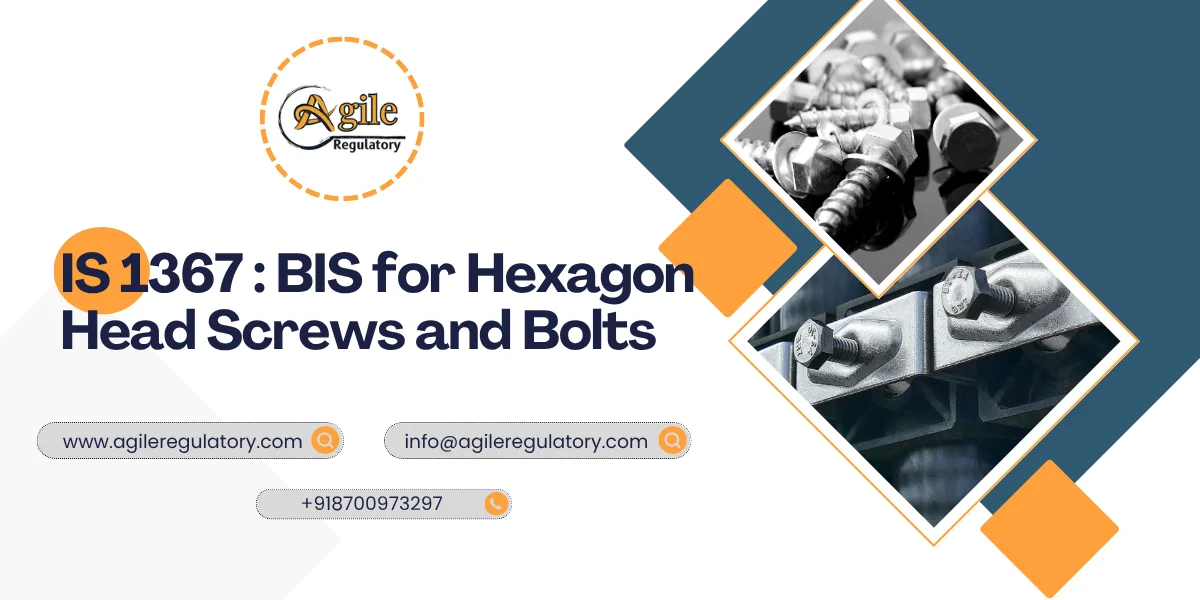
IS 1367 BIS Certification for Hexagon Head Screws and Bolts Grade A, B, and C
Page Contents (4)
When it comes to machine parts, one missing detail can cause bigger problems. In industries where accuracy and reliability are non-negotiable, the smallest fastener must meet high standards. The IS 1367 certification by the Bureau of Indian Standards (BIS) applies to hexagon head screws and bolts used across major mechanical, structural, and automotive systems.
Why Standardized Screws and Bolts Are a Must
Hexagon head screws and bolts are used when you need both strength and alignment. These fasteners must perform under pressure. If threads fail or heads shear, it can stop operations or even cause accidents. IS 1367 certification ensures that each bolt or screw has the right mechanical strength, thread precision, and tolerance levels based on its application.
The IS 1367 series contains multiple parts. Each part covers one specification—like mechanical properties, tolerances, or thread accuracy. The parts that apply to hex head fasteners focus on Grades A, B, and C, each representing a different level of precision.
BIS CRS Registration
What Are Grades A, B, and C in IS 1367
Not every bolt or screw is made equal. IS 1367 splits these fasteners into three grades:
Grade A – High Precision for Critical Use
Grade A fasteners are used in high-accuracy assemblies. These include automobile engines, aircraft, heavy-duty tools, or wherever fine alignment is required. The screws and bolts under this grade must meet tight tolerances for thread size, head shape, and length.
- Used in: High-speed engines, military equipment
- Tight tolerance: ±0.1 mm on diameter
- Thread finish: Class 6g/6H or better
- Material strength: 8.8 or above
Grade B – General Engineering Purposes
Grade B is a mid-range grade. These screws and bolts are made with moderate precision and are used in machine tools, factory equipment, or steel structures. Grade B allows more variation but still holds tight on strength.
- Used in: Tool machinery, structural equipment
- Tolerance range: ±0.2 mm
- Thread finish: Class 6g/6H
- Material strength: 6.8 or 8.8
Grade C – For Less Critical Assemblies
Grade C fasteners are made for general use where alignment is not critical, and load is not excessive. You’ll find them in non-load-bearing joints, covers, or temporary fixtures.
- Used in: HVAC panels, enclosures, household hardware
- Tolerance range: ±0.3 mm
- Thread finish: Class 8g/8H
- Material strength: 4.6 or below
IS 1367: Part-Wise Structure That Defines the Fasteners
The IS 1367 series is not a single document. It includes multiple parts, each defining something essential. For hex head fasteners, the most relevant parts are:
|
Part Number |
Title |
Focus |
|
IS 1367 (Part 3) |
Fasteners’ mechanical properties are made of carbon steel and alloy steel |
Tensile strength, hardness |
|
IS 1367 (Part 6) |
Tolerance on fasteners |
Dimensions and limits |
|
IS 1367 (Part 10) |
Fastener threads |
Thread profile and fit |
|
IS 1367 (Part 14) |
Torque/clamp force test |
Testing for torque and load |
Each of these must be followed strictly to get BIS certification. A manufacturer cannot choose only one part. All parts must be aligned with the application grade.
Get Free Consultation!
The BIS Certification Process for IS 1367
Getting certified under IS 1367 is not optional for manufacturers in India. It is mandatory under BIS guidelines if the product is for public infrastructure, defense, or export to countries that demand ISI-marked components.
1. Product Testing in BIS-Approved Lab
Before anything else, the product must be tested. The testing includes:
- Thread pitch accuracy
- Dimensional tolerance
- Head shape
- Shear and tensile strength
- Surface finish and coating durability
Testing must be done only at a BIS-recognized lab. Reports older than 3 months are not accepted.
2. Factory Inspection by BIS Officials
BIS visits the factory to verify the:
- Production machinery
- Calibration records
- Raw material traceability
- Internal quality controls
- Packaging and labeling systems
The plant must show that it can produce consistently with IS 1367 standards.
3. Grant of License
If everything checks out, BIS gives the manufacturer a CM/L license number and permits the use of the ISI mark on the certified products.
4. Ongoing Surveillance
Even after certification, BIS conducts surprise inspections. The manufacturer must:
- Maintain production logs
- Use ISI mark only on certified sizes and grades
- Keep a record of raw materials used
If you do not follow any of these, it will result in the suspension or cancellation of your license.
Labeling and Marking as per IS 1367
Once certified, manufacturers must follow strict labeling rules. Every box or bundle must carry:
- ISI mark with license number
- Size, grade, and thread type
- Batch number and date of manufacture
- Manufacturer’s name or logo
Improper or misleading labels can lead to penalties or revocation of license.
BIS Registration Process
Final Thoughts
The IS 1367 standard is the backbone of fastener quality in India. It breaks down a complex product into clear, measurable criteria. From thread tolerance to material grade, everything is covered. Whether you are a manufacturer, buyer, or OEM, understanding these grades can help you make informed, safe, and cost-effective decisions.
At Agile Regulatory, we help businesses with complete BIS certification services for IS 1367 fasteners. From lab testing to document filing and audit support, we manage everything with accuracy and speed. Let our experts ensure your products meet every BIS requirement without delay.

About the Author
View ProfileNishi Chawla
Content Writer & Compliance Specialist
Nishi is an expert content writer with expertise in Business Legal Compliances, Certifications, and Registrations — BIS, EPR, Medical Devices, Cosmetics, Drugs, and Import Export. She holds a B.Com from the University of Delhi and has been writing industry content since 2019.